10/30/2014

Ti/Tv


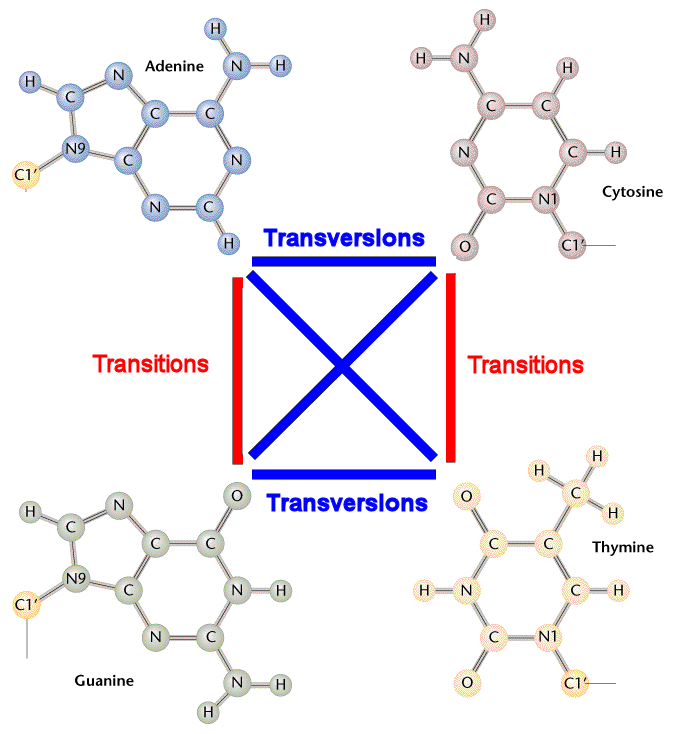
DNA substitution mutations are of two types. Transitions are interchanges of two-ring purines (A G) or of one-ring pyrimidines (C T): they therefore involve bases of similar shape. Transversions are interchanges of purine for pyrimidine bases, which therefore involve exchange of one-ring and two-ring structures.

    Although there are twice as many possible transversions, because of the molecular mechanisms by which they are generated, transition mutations are generated at higher frequency  than transversions. As well, transitions are less likely to result in amino acid substitutions (due to "wobble"), and are therefore more likely to persist as "silent substitutions" in populations as single nucleotide polymorphisms (SNPs).


http://www.mun.ca/biology/scarr/Transitions_vs_Transversions.html


Transition to Transversion Ratio 

Human mutations don't occur randomly. In fact, transitions (changes from A <-> G and C <-> T) are expected to occur twice as frequently as transversions (changes from A <-> C, A <-> T, G <-> C or G <-> T). Thus, another useful diagnostic is the ratio of transitions to transversions in a particular set of SNP calls. This ratio is often evaluated separately for previously discovered and novel SNPs.

Across the entire genome the ratio of transitions to transversions is typically around 2. In protein coding regions, this ratio is typically higher, often a little above 3. The higher ratio occurs because, especially when they occur in the third base of a codon, transversions are much more likely to change the encoded amino acid. A refinement to this analysis, in protein coding regions, is to examine the transition to transversion ratio separately for non-degenerate, two-fold degenerate, three-fold degenerate and four-fold degenerate sites.

http://genome.sph.umich.edu/wiki/SNP_Call_Set_Properties


Some useful papers:

Transition-Transversion Bias Is Not Universal: A Counter Example from Grasshopper Pseudogenes 
http://www.plosgenetics.org/article/info%3Adoi%2F10.1371%2Fjournal.pgen.0030022

Estimation of the transition/transversion rate bias and species sampling
http://www.ncbi.nlm.nih.gov/pubmed/10093216
Mutational and fitness landscapes of an RNA virus revealed through population sequencing
http://www.nature.com/nature/journal/v505/n7485/full/nature12861.html
 

10/28/2014

wget --random-wait


 --random-wait

Some web sites may perform log analysis to identify retrieval programs such as Wget by looking for statistically significant similarities in the time between requests. This option causes the time between requests to vary between 0.5 and 1.5 * wait seconds, where wait was specified using the --wait option, in order to mask Wget’s presence from such analysis.

A 2001 article in a publication devoted to development on a popular consumer platform provided code to perform this analysis on the fly.  Its author suggested blocking at the class C address level to ensure automated retrieval programs were blocked despite changing DHCP-supplied addresses.

The --random-wait option was inspired by this ill-advised recommendation to block many unrelated users from a web site due to the actions of one.

10/25/2014

Install OpenVPN

Mainly refer to these web pages:
http://geek-kb.com/linux/install-and-configure-openvpn-centos-6-x/  (Tried this tutorial, but failed. Service failed.)
https://bugzilla.redhat.com/show_bug.cgi?id=966373   (In server.conf, plugin path was different for v2.3.1)

Try older version with "yum downgrade"!
http://www.sohailriaz.com/how-to-downgrade-rpm-package-using-yum/
http://blog.adityapatawari.com/2012/05/how-to-downgrade-or-reinstall-rpm.html


The following videos are based on openvpn-2.2.2.

VPN Setup using OpenVPN on CentOS 6.3 - part 1/2 

VPN Setup using OpenVPN on CentOS 6.3 - part 2/2


10/09/2014

Adding Custom Tracks to Ensembl

http://grch37.ensembl.org/info/website/upload/index.html

Integrate private data into Ensembl Genome Browser


10/01/2014

$300M Boost for BRAIN

http://www.the-scientist.com/?articles.view/articleNo/41127/title/-300M-Boost-for-BRAIN/

President Obama’s BRAIN Initiative will receive an additional $300 million in funding thanks to an influx of public, private, philanthropic, and academic investments, the White House announced today (September 30). In addition, the US Food and Drug Administration (FDA) and the Intelligence Advanced Research Projects Agency (IARPA) join the National Institutes of Health (NIH), the National Science Foundation (NSF), and the Defense Advanced Research Projects Agency (DARPA) in supporting the initiative. Further, the NIH today announced $46 million in grants for BRAIN, which was launched in April 2013 and aims to fully map the human brain.
Given the variety of funding partners, “I see something emerging that’s very different from other science initiatives that we’ve seen previously,” said said Paul Alivisatos of the University of California, Berkeley, who moderated a panel at today’s White House BRAIN Conference. “BRAIN may turn out to be a model of what a new science initiative is.”
“There’s a big gap between what we want to do in brain research and the technologies available to make exploration possible,” NIH Director Francis Collins said in the statement. “These initial awards are . . . focused on developing the tools and technologies needed to make the next leap in understanding the brain.”
“The BRAIN Initiative is truly an exciting and potentially game-changing effort to unlock the secrets of one of humankind’s most enduring mysteries,” NSF Director France Córdova said in a statement.

9/27/2014

Maintaining stable ids between GRCh37 and GRCh38

http://www.ensembl.info/blog/2014/07/08/maintaining-stable-ids-between-grch37-and-grch38/

As mentioned in another post, due to the presence of patches in both GRCh37 and GRCh38, the assembly mapping has proven challenging.
Related to this, another novelty arises when assigning stable ids to genes.
Every time a gene set is updated for a species, we compare the newest gene set with the previous one.
If we find a perfect match between the two gene sets, the stable id assigned to the older model will be used for the new model.
Even if the model has changed slightly (longer UTR for example), we try to map the old stable id whenever possible, with a version change to indicate that it was not a perfect match.
To provide a better comparison between the last GRCh37 gene set (e!75) and the new GRCh38 gene set (e!76), we have decided to project the old set onto the new assembly. This allows for overlap comparisons rather than simple sequence alignments. However, this means that around 2% of the genes are lost, as they can not be mapped onto the new assembly. If these gene models are still present in the new assembly, they are being assigned a new stable id.
Putting this in perspective of patch fixes integrated into the new reference, we also have cases where two genes in GRCh37 (one of the reference, one on the patch) both match the same gene on the new reference in GRCh38.
In that case, we have decided to arbitrarily keep the longest standing stable ID, which is likely to be the one on the reference.
The stable ID which was used on the patch is recorded as retired but a link is provided to its replacement. For example, searching for ENSG00000260384 (SERINC2 gene on HG989_PATCH) will redirect the user to ENSG00000168528 (SERINC2 on the primary assembly).
Screen Shot 2014-06-27 at 10.46.23Screen Shot 2014-06-27 at 10.48.13
This resulted in the deletion of around 3% of our genes.
In other cases, the difference between the GRCh37 reference (without patch) and the GRCh38 reference (with integrated patch fix from GRCh37) is too important to project annotations from the reference. Only annotations from the patch are then kept, along with the stable ids. For these cases, if there is a known alt_allele to a gene on the GRCh37 reference, it is added as a link to its equivalent on the patch.
Consequently, searching for ENSG00000183678 (CTAG1A gene on the GRCh37 primary assembly) will redirect the user to ENSG00000268651 (CTAG1A gene on HG1497_PATCH in GRCh37, on the primary assembly in GRCh38).
As mentioned in the blog post about the new gene set, a new assembly implies a number of underlying changes in the gene structure.
Despite this, 95% of all the gene stable ids have been assigned to the new gene models.
With this work, we try and ensure that you will still be able to find your favourite gene using the same stable id as in GRCh37.