8/27/2015

China announces stem-cell rules

http://www.nature.com/news/china-announces-stem-cell-rules-1.18252

Many scientists have been itching to get started.
Qi Zhou, a stem-cell and cloning scientist at the Chinese Academy of Sciences (CAS) Institute of Zoology in Beijing, has been waiting for the guidelines so he can move his research from animal models to humans. In unpublished work, his team has already implanted dopamine-producing neurons derived from stem cells into monkeys that have been chemically induced to show symptoms similar to those of Parkinson’s disease. The monkeys have shown some improvement, and he now hopes to try the treatment on humans. “I think it’s time, time to start doing some clinical research,” he says.
Jianwu Dai, a regenerative-medicine specialist at the CAS Institute of Genetics and Developmental Biology in Beijing, hopes to implant a small collagen scaffold seeded with stem cells into humans to try to repair spinal-cord injuries. His team has treated some 25 people using the scaffold seeded with mononuclear cells, a type of blood cell taken from bone marrow, and Dai says he has seen some improvements. But he thinks that neural stem cells derived from embryonic stem cells will deliver better results.
........
 

8/14/2015

Fish Oil May Slow Schizophrenia

Omega-3 supplementation reduced progression rates among people with early-stage symptoms of schizophrenia, according to a small trial.

Seven years ago, investigators enrolled 81 people aged 13 to 25 with early signs of schizophrenia in a clinical trial to test the effects of omega-3 fish oil pills. A paper published this week (August 11) in Nature Communications reported on 71 of those participants, pointing to a notable benefit of the supplements: only 10 percent of those taking fish oils ultimately developed schizophrenia, compared with 40 percent of the placebo group.
“I don’t want to sound like a cynic or a skeptic, but it’s almost too good to be true,” psychiatrist Jeffrey Lieberman of Columbia University Medical Center in New York City who was not involved in the study told ScienceNews.
Schizophrenia usually starts to manifest in the first 20 to 30 years of life, with minor delusions and paranoid thoughts often occurring in the teenage years or younger. But only about a third of people who present with such early symptoms eventually develop psychosis, New Scientist reported. After researchers found that the blood cells of schizophrenia patients have lower levels of omega-3 fatty acids than those of healthy controls, scientists in the field began to investigate the possibility that supplementing these compounds could treat the disorder. Results of early trials have been mixed, but this latest study points to the potential benefit of fatty acids if taken early enough.
“Schizophrenia is a major cause of disability, but early treatment has been linked to better outcomes,” coauthor Paul Amminger at the University of Melbourne in Australia told The Guardian. “Our study gives hope that there may be alternatives to antipsychotic medication.”

http://www.the-scientist.com/?articles.view/articleNo/43733/title/Fish-Oil-May-Slow-Schizophrenia/

http://www.nature.com/ncomms/2015/150811/ncomms8934/full/ncomms8934.html

7/24/2015

When Does a Smart Mouse Become Human?


© DUSAN PETRICICLate last year, Steve Goldman of the University of Rochester and his colleagues reported that they had transplanted immature glial cells from donated human fetuses into the brains of immunodeficient mouse pups. These human glial cells matured into astrocytes and developed as the primary astrocyte population in the newborn mouse brain. One unexpected outcome of the team’s research, published in the Journal of Neuroscience (34:16153-61), was that these human-mouse chimeras outperformed normal mice almost fourfold in a variety of cognition tests, underscoring the importance of astrocytes in regulating synaptic plasticity and neural connectivity to enhance learning and memory. But the study also raised important ethical considerations—namely, what biological properties differentiate Homo sapiens from other organisms, and when should such “humanized” animals be afforded the rights that people currently enjoy.

....

 http://www.the-scientist.com//?articles.view/articleNo/43327/title/When-Does-a-Smart-Mouse-Become-Human-/

4/14/2015

Linkage Disequilibrium Blocks/Triangles

cited from:
https://estrip.org/articles/read/tinypliny/44920/Linkage_Disequilibrium_Blocks_Triangles.html


07/10/08 05:51 - 75ºF - ID#44920
Linkage Disequilibrium Blocks/Triangles

I just had a zen moment in the interpretation of Linkage Disequilibrium Maps. (Also called LD maps, LD blocks, LD triangles - take your pick.) Turns out I was actually sweating 1st grade stuff!

I found that NO ONE explains this EXTRAORDINARILY SIMPLE thing in their umpteen papers, reviews, tutorials and what-nots. I just want to post this here so that when people google this simple little question, they find an equally simple and straight-forward answer!

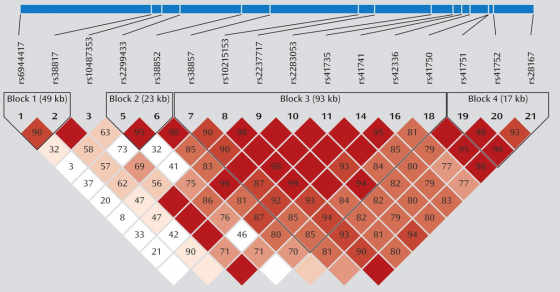
This is an example of what a very small section of a Linkage Disequilibrium Map or an LD Map looks like.
image

Concentrate on the upper part of the map.
image

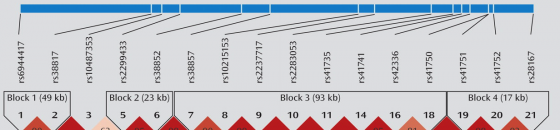
The thick blue line represents a strand of a chromosome. The white bars on the blue line of the chromosome are SNPs (Single Nucleotide Polymorphisms) that have been identified and sequenced. This means that we know what initial Nucleotide base has morphed into what final Nucleotide base. (Thus making it a polymorphic locus - or a position on the chromosome that exists in more than one form. The two forms are the intial nucleotide base and the final nucleotide base.)

These SNP locations or loci are labeled in this picture as 1, 2, 3, ... and so on. Each of these SNPs has a name that starts with rsXXXXX where XXXXX is some numeric code. Each SNP is represented by a labeled grey triangle below the thick blue line (the chromosome).

image

The purpose of an LD map is to tell us whether any two given SNPs are INHERITED TOGETHER in an offspring. In other words, we want to know if any two given SNPs are in Linkage Disequilibrium.

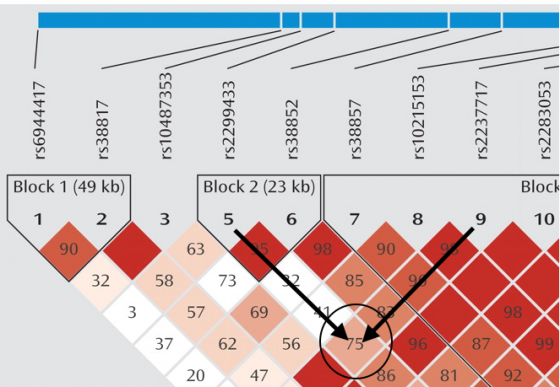
An example: Are say, SNP #5 and SNP #9 in linkage disequilibrium? You trace down the column leading from grey triangle #5 or SNP#5 (Name: rs2299433) going toward SNP #9 (rs2237717). Do the same for SNP #9 going toward SNP #5.
image

The square in which the columns leading from SNP #5 and SNP #9 intersect is the one you should focus on. I have encircled it above. As you can see its a LIGHT RED and has a number, 75. Thus SNP#5 and SNP #9 have a correlation of 0.75 and are in fairly high linkage disequilibrium with each other.

In simple terms, if your square of focus is a deep red, then the two SNPs you are interested in have the highest correlation with each other and have a highest Linkage Disequilibrium. Thus, one of them can easily act as a proxy for another. The lighter the shade of red, the lesser is the correlation between the two SNPs. For example, SNP #5 and SNP #7 have a low correlation (0.32) with each other. Thus, you cannot reliably take SNP #5 and say that it could possibly act as a proxy for SNP #7.

LD Maps also tell us about HAPLOTYPE blocks. See the blocks labeled, "Block 1 (49kb)", "Block 2 (23kb)", "Block 3 (93kb)" ... and so on.
image

These triangles or the blocks of dark red represent SNPs that are all in high linkage disequilibrium with each other and thus are all inherited together. They are also on the same section of the chromosome. These SNPs form a HAPLOTYPE. Every big red triangle or block in the LD map indicates a HAPLOTYPE on the corresponding stretch of the chromosome above. You only need to look at one or maximum a couple SNPs in a haplotype to know about the fate of the entire section of the chromosome that forms a Haplotype. It saves money and time.

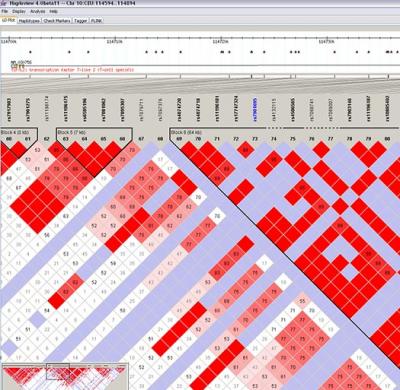
The HapMap Consortium project has painstakingly constructed such an LD map for each and every known SNP in the entire human genome. Their LD maps look somewhat like this (using the haploview software: )
image

Though it is complicated, if you followed the simple tutorial above, you should be able to make sense of even complicated maps such as these. You are most welcome to leave a comment or drop me an email if you need further clarification!

I don't care who is laughing at this ridiculously detailed explanation of a kindergarten concept in genetics and genomics. Personally, I am just EXTREMELY relieved to finally know it well enough to be able to explain it. :)
printadd/read comments
Permalink: Linkage_Disequilibrium_Blocks_Triangles.html
Words: 714
Location: Buffalo, NY
Last Modified: 08/28/14 06:01

3/08/2015

Linux文件删除与恢复

使用 Linux 安全删除工具
http://www.ibm.com/developerworks/cn/linux/1311_caoyq_linuxdelete/index.html

使用 Linux 文件恢复工具
http://www.ibm.com/developerworks/cn/linux/1312_caoyq_linuxrestore/index.html

2/11/2015

grid cell


Grid cell symmetry is shaped by environmental geometry
Nature 518, 232–235 (12 February 2015) doi:10.1038/nature14153
Editor's summary
The neuronal grid cells of the entorhinal cortex fire in a spatial grid pattern laid out across the surface of a familiar environment to provide the brain with an internal map of an animal's surroundings. The role of environmental boundaries in the construction of this pattern is not well understood. Early studies had suggested that properties such as symmetry, orientation and scale of grid cells' firing patterns were independent of an environment's shape. But now two separate papers in this issue of Nature — one from Edvard Moser and colleagues and the other from John O'Keefe and colleagues — demonstrate that grid orientation, scale, symmetry and homogeneity can be strongly affected by environmental geometry, with grid cells aligned with the borders of the environment at an offset of a few degrees such that it minimizes symmetry with boundaries. These findings suggest a mechanism by which the geometry of an environment causes local rotation and deformation of the hexagonal firing patterns of grid cells.


1/02/2015

update firefox to version 34

Failed to sync firefox31 info to firefox34.

Unlink the old device, then re-create a new account to sync the personal settings across different devices.

Two useful links:

http://www.libre-software.net/how-to-install-firefox-on-ubuntu-linux-mint

https://www.mozilla.org/en-US/firefox/all/

The new version is ready to run. No need to compile it. Very  convenient!

11/24/2014

sequenced plant genomes

A list of sequenced plant genomes

(periodically updated)

https://genomevolution.org/wiki/index.php/Sequenced_plant_genomes

11/18/2014

KO, KD, Knockin

gene knockdown
http://en.wikipedia.org/wiki/Gene_knockdown

gene knockout
http://en.wikipedia.org/wiki/Gene_knockout

gene knockin
http://en.wikipedia.org/wiki/Gene_knockin


11/13/2014

bim, bam, ngsfse2?

files produced by FusionMap.
unclear about what they are (bim, ngsfse2).
for later processing ....


https://www.biostars.org/p/15608/

http://en.wikipedia.org/wiki/Building_information_modeling

http://www.autodesk.com/solutions/building-information-modeling/overview


http://www.arrayserver.com/wiki/index.php?title=SummaryType

perl heredoc

http://perl.about.com/od/perltutorials/qt/perlheredoc.htm


http://perldoc.perl.org/perlop.html#%3C%3CEOF


10/30/2014

Ti/Tv


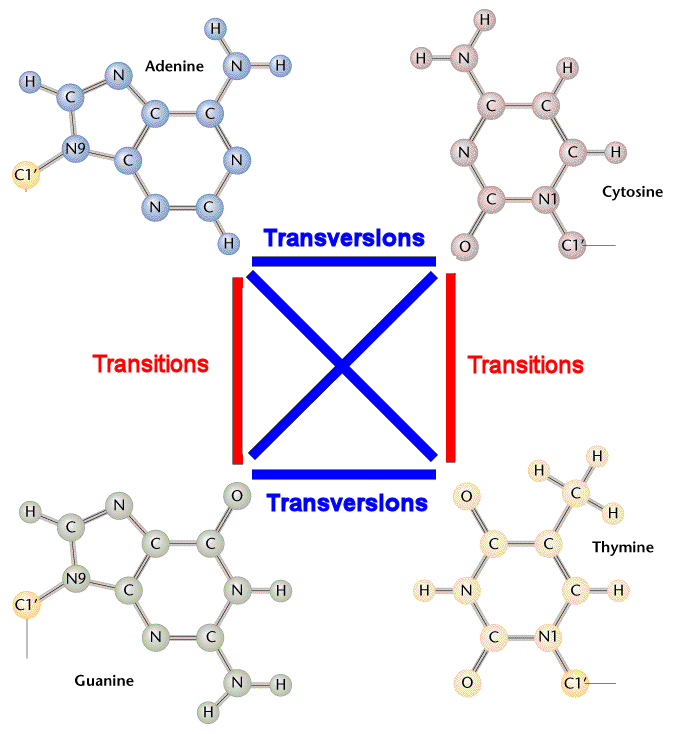
DNA substitution mutations are of two types. Transitions are interchanges of two-ring purines (A G) or of one-ring pyrimidines (C T): they therefore involve bases of similar shape. Transversions are interchanges of purine for pyrimidine bases, which therefore involve exchange of one-ring and two-ring structures.

    Although there are twice as many possible transversions, because of the molecular mechanisms by which they are generated, transition mutations are generated at higher frequency  than transversions. As well, transitions are less likely to result in amino acid substitutions (due to "wobble"), and are therefore more likely to persist as "silent substitutions" in populations as single nucleotide polymorphisms (SNPs).


http://www.mun.ca/biology/scarr/Transitions_vs_Transversions.html


Transition to Transversion Ratio 

Human mutations don't occur randomly. In fact, transitions (changes from A <-> G and C <-> T) are expected to occur twice as frequently as transversions (changes from A <-> C, A <-> T, G <-> C or G <-> T). Thus, another useful diagnostic is the ratio of transitions to transversions in a particular set of SNP calls. This ratio is often evaluated separately for previously discovered and novel SNPs.

Across the entire genome the ratio of transitions to transversions is typically around 2. In protein coding regions, this ratio is typically higher, often a little above 3. The higher ratio occurs because, especially when they occur in the third base of a codon, transversions are much more likely to change the encoded amino acid. A refinement to this analysis, in protein coding regions, is to examine the transition to transversion ratio separately for non-degenerate, two-fold degenerate, three-fold degenerate and four-fold degenerate sites.

http://genome.sph.umich.edu/wiki/SNP_Call_Set_Properties


Some useful papers:

Transition-Transversion Bias Is Not Universal: A Counter Example from Grasshopper Pseudogenes 
http://www.plosgenetics.org/article/info%3Adoi%2F10.1371%2Fjournal.pgen.0030022

Estimation of the transition/transversion rate bias and species sampling
http://www.ncbi.nlm.nih.gov/pubmed/10093216
Mutational and fitness landscapes of an RNA virus revealed through population sequencing
http://www.nature.com/nature/journal/v505/n7485/full/nature12861.html
 

10/28/2014

wget --random-wait


 --random-wait

Some web sites may perform log analysis to identify retrieval programs such as Wget by looking for statistically significant similarities in the time between requests. This option causes the time between requests to vary between 0.5 and 1.5 * wait seconds, where wait was specified using the --wait option, in order to mask Wget’s presence from such analysis.

A 2001 article in a publication devoted to development on a popular consumer platform provided code to perform this analysis on the fly.  Its author suggested blocking at the class C address level to ensure automated retrieval programs were blocked despite changing DHCP-supplied addresses.

The --random-wait option was inspired by this ill-advised recommendation to block many unrelated users from a web site due to the actions of one.

10/25/2014

Install OpenVPN

Mainly refer to these web pages:
http://geek-kb.com/linux/install-and-configure-openvpn-centos-6-x/  (Tried this tutorial, but failed. Service failed.)
https://bugzilla.redhat.com/show_bug.cgi?id=966373   (In server.conf, plugin path was different for v2.3.1)

Try older version with "yum downgrade"!
http://www.sohailriaz.com/how-to-downgrade-rpm-package-using-yum/
http://blog.adityapatawari.com/2012/05/how-to-downgrade-or-reinstall-rpm.html


The following videos are based on openvpn-2.2.2.

VPN Setup using OpenVPN on CentOS 6.3 - part 1/2 

VPN Setup using OpenVPN on CentOS 6.3 - part 2/2


10/09/2014

Adding Custom Tracks to Ensembl

http://grch37.ensembl.org/info/website/upload/index.html

Integrate private data into Ensembl Genome Browser


10/01/2014

$300M Boost for BRAIN

http://www.the-scientist.com/?articles.view/articleNo/41127/title/-300M-Boost-for-BRAIN/

President Obama’s BRAIN Initiative will receive an additional $300 million in funding thanks to an influx of public, private, philanthropic, and academic investments, the White House announced today (September 30). In addition, the US Food and Drug Administration (FDA) and the Intelligence Advanced Research Projects Agency (IARPA) join the National Institutes of Health (NIH), the National Science Foundation (NSF), and the Defense Advanced Research Projects Agency (DARPA) in supporting the initiative. Further, the NIH today announced $46 million in grants for BRAIN, which was launched in April 2013 and aims to fully map the human brain.
Given the variety of funding partners, “I see something emerging that’s very different from other science initiatives that we’ve seen previously,” said said Paul Alivisatos of the University of California, Berkeley, who moderated a panel at today’s White House BRAIN Conference. “BRAIN may turn out to be a model of what a new science initiative is.”
“There’s a big gap between what we want to do in brain research and the technologies available to make exploration possible,” NIH Director Francis Collins said in the statement. “These initial awards are . . . focused on developing the tools and technologies needed to make the next leap in understanding the brain.”
“The BRAIN Initiative is truly an exciting and potentially game-changing effort to unlock the secrets of one of humankind’s most enduring mysteries,” NSF Director France Córdova said in a statement.

9/27/2014

Maintaining stable ids between GRCh37 and GRCh38

http://www.ensembl.info/blog/2014/07/08/maintaining-stable-ids-between-grch37-and-grch38/

As mentioned in another post, due to the presence of patches in both GRCh37 and GRCh38, the assembly mapping has proven challenging.
Related to this, another novelty arises when assigning stable ids to genes.
Every time a gene set is updated for a species, we compare the newest gene set with the previous one.
If we find a perfect match between the two gene sets, the stable id assigned to the older model will be used for the new model.
Even if the model has changed slightly (longer UTR for example), we try to map the old stable id whenever possible, with a version change to indicate that it was not a perfect match.
To provide a better comparison between the last GRCh37 gene set (e!75) and the new GRCh38 gene set (e!76), we have decided to project the old set onto the new assembly. This allows for overlap comparisons rather than simple sequence alignments. However, this means that around 2% of the genes are lost, as they can not be mapped onto the new assembly. If these gene models are still present in the new assembly, they are being assigned a new stable id.
Putting this in perspective of patch fixes integrated into the new reference, we also have cases where two genes in GRCh37 (one of the reference, one on the patch) both match the same gene on the new reference in GRCh38.
In that case, we have decided to arbitrarily keep the longest standing stable ID, which is likely to be the one on the reference.
The stable ID which was used on the patch is recorded as retired but a link is provided to its replacement. For example, searching for ENSG00000260384 (SERINC2 gene on HG989_PATCH) will redirect the user to ENSG00000168528 (SERINC2 on the primary assembly).
Screen Shot 2014-06-27 at 10.46.23Screen Shot 2014-06-27 at 10.48.13
This resulted in the deletion of around 3% of our genes.
In other cases, the difference between the GRCh37 reference (without patch) and the GRCh38 reference (with integrated patch fix from GRCh37) is too important to project annotations from the reference. Only annotations from the patch are then kept, along with the stable ids. For these cases, if there is a known alt_allele to a gene on the GRCh37 reference, it is added as a link to its equivalent on the patch.
Consequently, searching for ENSG00000183678 (CTAG1A gene on the GRCh37 primary assembly) will redirect the user to ENSG00000268651 (CTAG1A gene on HG1497_PATCH in GRCh37, on the primary assembly in GRCh38).
As mentioned in the blog post about the new gene set, a new assembly implies a number of underlying changes in the gene structure.
Despite this, 95% of all the gene stable ids have been assigned to the new gene models.
With this work, we try and ensure that you will still be able to find your favourite gene using the same stable id as in GRCh37.

9/24/2014

different ls output to terminal and pipe

Try these commands:

ls -1 | wc -l
ls | wc -l
ls | cat

We can use the first two commands to count the number of files. It is easy to understand the first one works. But the second command does not seem to work as expected at the first glance. However, you will find it really works the same way as the first one. The reason can be seen from the last command -- ls outputs the results to pipe in the same way as "ls -1" to terminal.

http://unix.stackexchange.com/questions/157285/why-does-ls-wc-l-show-the-correct-number-of-files-in-current-directory

http://git.savannah.gnu.org/cgit/coreutils.git/tree/src/ls.c

Jewish Holidays 2014-2015

http://www.hebcal.com/holidays/2014-2015

Major holidays

Dates in bold are yom tov, so they have similar obligations and restrictions to Shabbat in the sense that normal "work" is forbidden.
HolidayDatesDescription
Rosh Hashana -, 2014 The Jewish New Year
Yom Kippur Day of Atonement
Sukkot -, 2014
-, 2014
Feast of Tabernacles
Shmini Atzeret Eighth Day of Assembly
Simchat Torah Day of Celebrating the Torah
Chanukah -, 2014 The Jewish festival of rededication, also known as the Festival of Lights
Purim Purim is one of the most joyous and fun holidays on the Jewish calendar
Pesach -, 2015
-, 2015
-, 2015
Passover, the Feast of Unleavened Bread
Shavuot -, 2015 Festival of Weeks, commemorates the giving of the Torah at Mount Sinai
Tish'a B'Av The Ninth of Av, fast commemorating the destruction of the two Temples


Minor holidays

HolidayDatesDescription
Tu BiShvat New Year for Trees
Purim Katan
Minor Purim celebration during Adar I on leap years
Shushan Purim Purim celebrated in Jerusalem and walled cities
Days of the Omer
7 weeks from the second night of Pesach to the day before Shavuot
Pesach Sheni Second Passover, one month after Passover
Lag B'Omer 33rd day of counting the Omer
Leil Selichot Sep 5, 2015 Prayers for forgivenes in preparation for the High Holidays

Minor fasts

HolidayDatesDescription
Tzom Gedaliah Sep 28, 2014 Fast of the Seventh Month, commemorates the assassination of the Jewish governor of Judah
Asara B'Tevet Jan 1, 2015 Fast commemorating the siege of Jerusalem
Ta'anit Esther Mar 4, 2015 Fast of Esther
Ta'anit Bechorot Apr 3, 2015 Fast of the First Born
Tzom Tammuz Jul 5, 2015 Fast commemorating breaching of the walls of Jerusalem by Nebuchadnezzar

Modern holidays

HolidayDatesDescription
Yom HaShoah Holocaust Memorial Day
Yom HaZikaron Israeli Memorial Day
Yom HaAtzma'ut Israeli Independence Day
Yom Yerushalayim Jerusalem Day

Special Shabbatot

HolidayDatesDescription
Shabbat Shuva Shabbat that falls between Rosh Hashanah and Yom Kippur (Shabbat of Returning)
Shabbat Shekalim Shabbat before Rosh Chodesh Adar
Shabbat Zachor Shabbat before Purim
Shabbat Parah Shabbat of the Red Heifer
Shabbat HaChodesh Shabbat before Rosh Chodesh Nissan
Shabbat HaGadol Shabbat before Pesach
Shabbat Chazon Shabbat before Tish'a B'Av (Shabbat of Prophecy/Shabbat of Vision)
Shabbat Nachamu Shabbat after Tish'a B'Av (Shabbat of Consolation)
Shabbat Rosh Chodesh
When Shabbat falls on Rosh Chodesh
Shabbat Machar Chodesh
When Shabbat falls the day before Rosh Chodesh

Rosh Chodesh

HolidayDatesDescription
Rosh Chodesh Cheshvan Beginning of new Hebrew month of Cheshvan
Rosh Chodesh Kislev Beginning of new Hebrew month of Kislev
Rosh Chodesh Tevet Beginning of new Hebrew month of Tevet
Rosh Chodesh Sh'vat Beginning of new Hebrew month of Sh'vat
Rosh Chodesh Adar Beginning of new Hebrew month of Adar
Rosh Chodesh Adar II
Beginning of new Hebrew month of Adar II (on leap years)
Rosh Chodesh Nisan Beginning of new Hebrew month of Nisan
Rosh Chodesh Iyyar Beginning of new Hebrew month of Iyyar
Rosh Chodesh Sivan Beginning of new Hebrew month of Sivan
Rosh Chodesh Tamuz Beginning of new Hebrew month of Tamuz
Rosh Chodesh Av Beginning of new Hebrew month of Av
Rosh Chodesh Elul Beginning of new Hebrew month of Elul